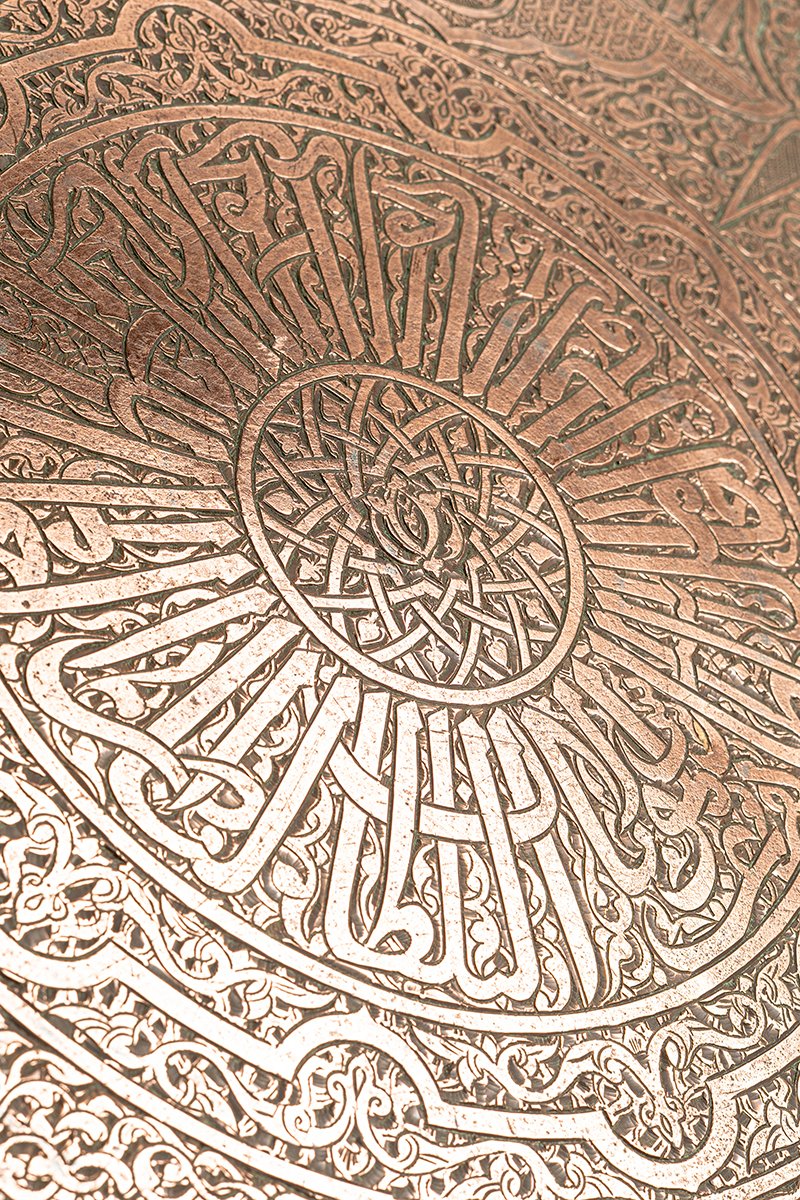
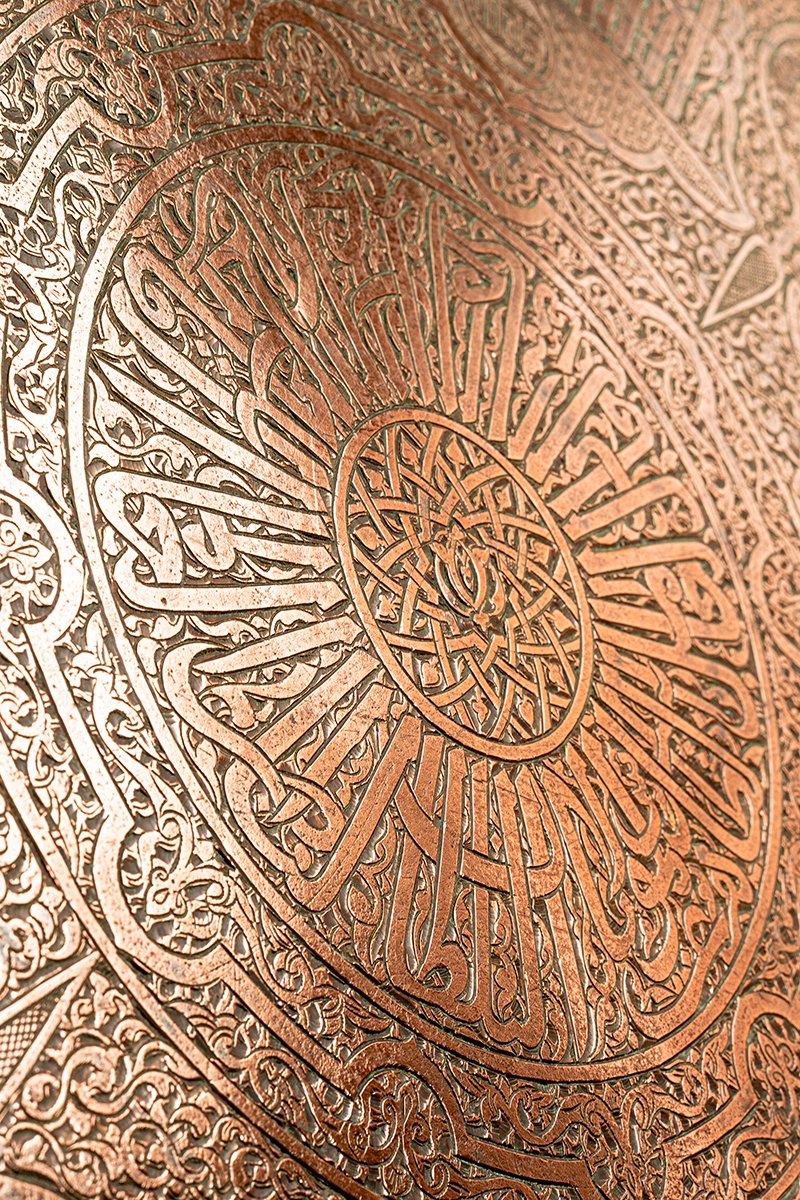
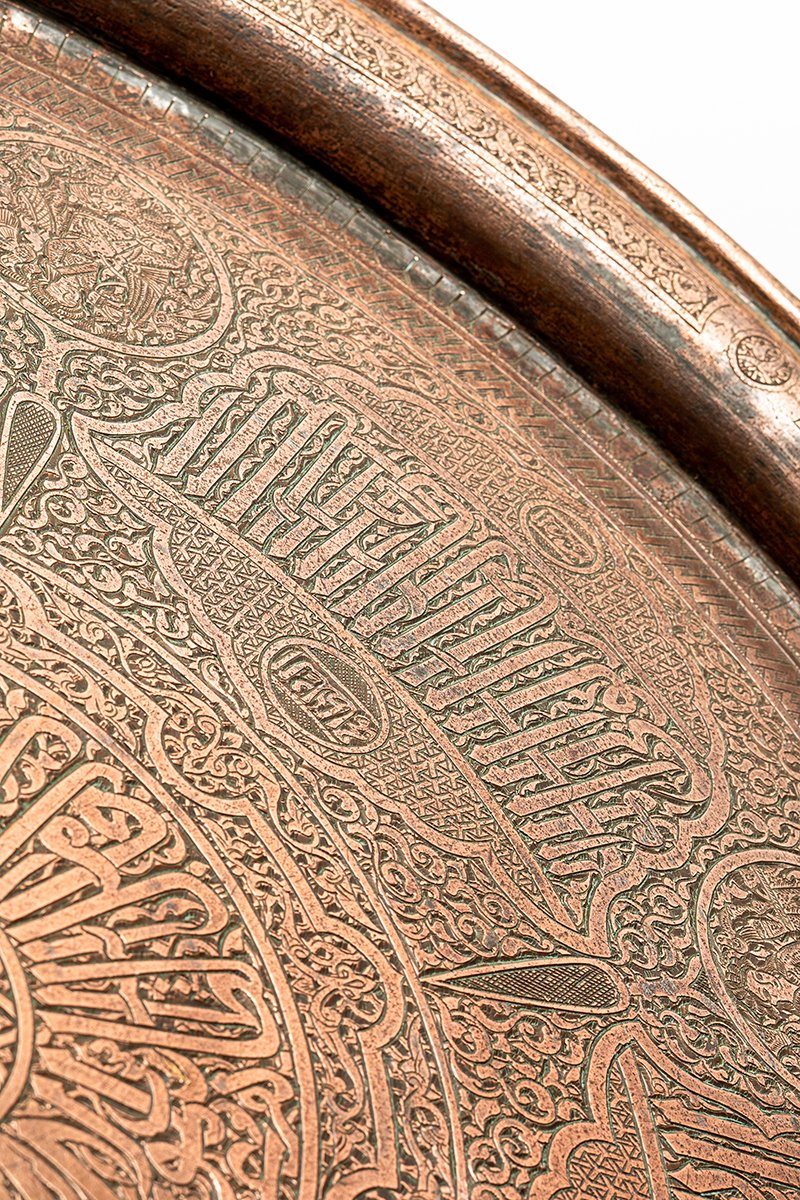
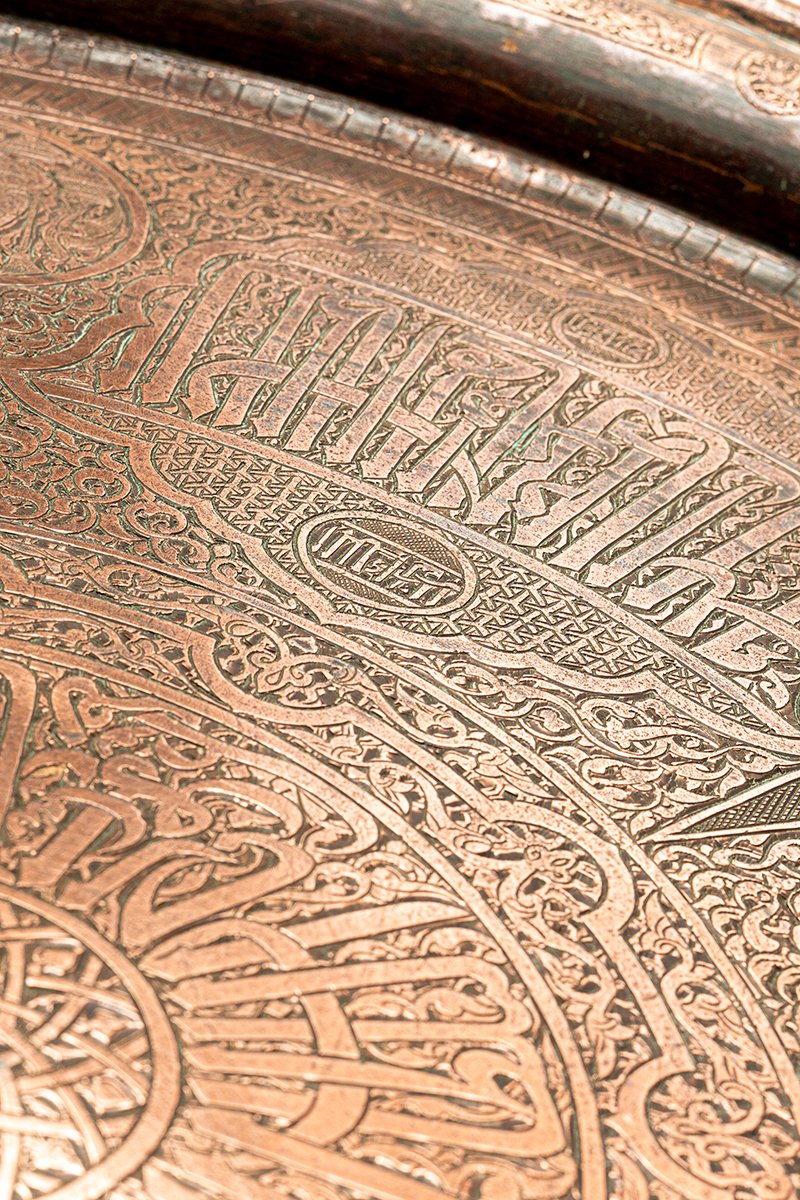
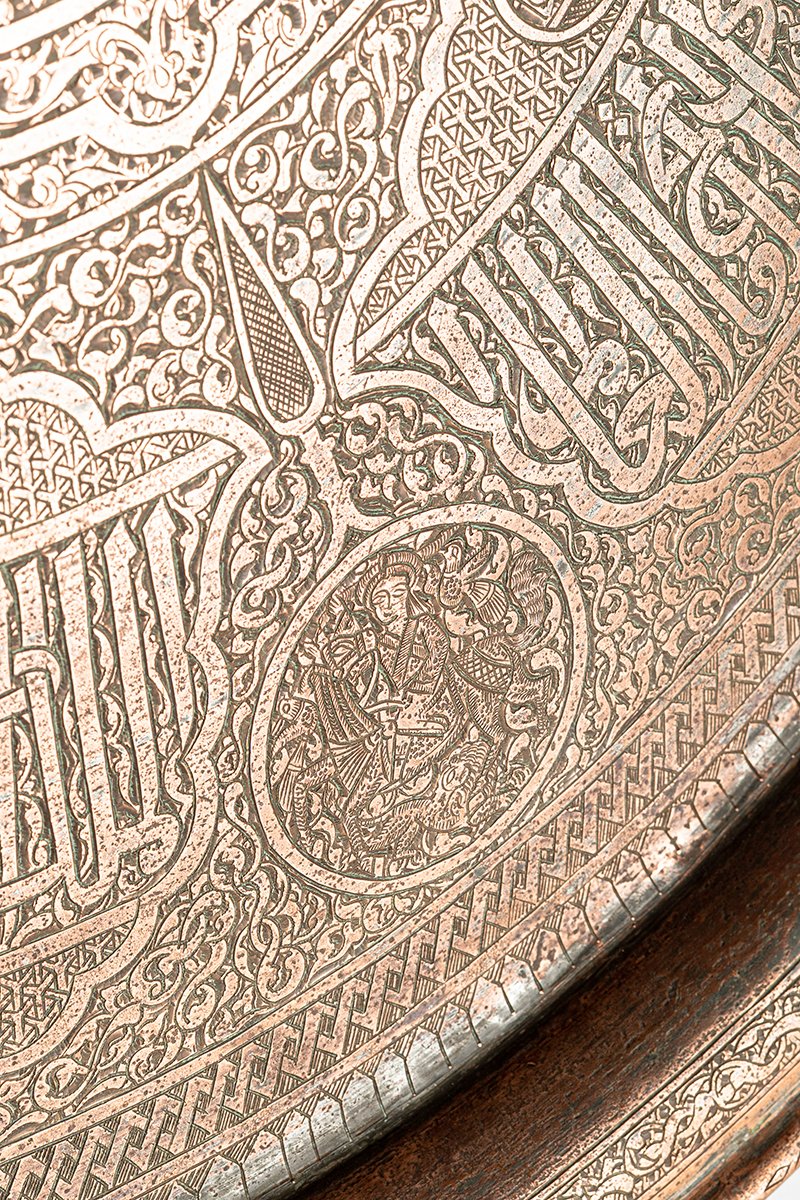
This brass tray unfolds like a crafted chronicle in metal, each band and medallion layering text and image into a continuous story. At the center radiates a sunburst of calligraphy, its interlaced lines forming a lattice of divine words that anchor the entire composition. Surrounding this emblem, elongated cartouches stretch outward, inscribed with dense Arabic script, while smaller roundels interrupt the flow with figural scenes, balancing text with imagery.
Within these roundels appear finely worked images: mounted riders, attendants, and courtiers rendered in layered garments and detailed armor. Their presence enlivens the tray with action, duels, processions, and ceremonial gestures, transforming the script into a stage where faith and worldly authority intersect. Among them are six knights, each distinct, including one dramatically shown holding a deer he has just hunted, its body dragged in triumph, a vivid symbol of dominion over both nature and battlefield.
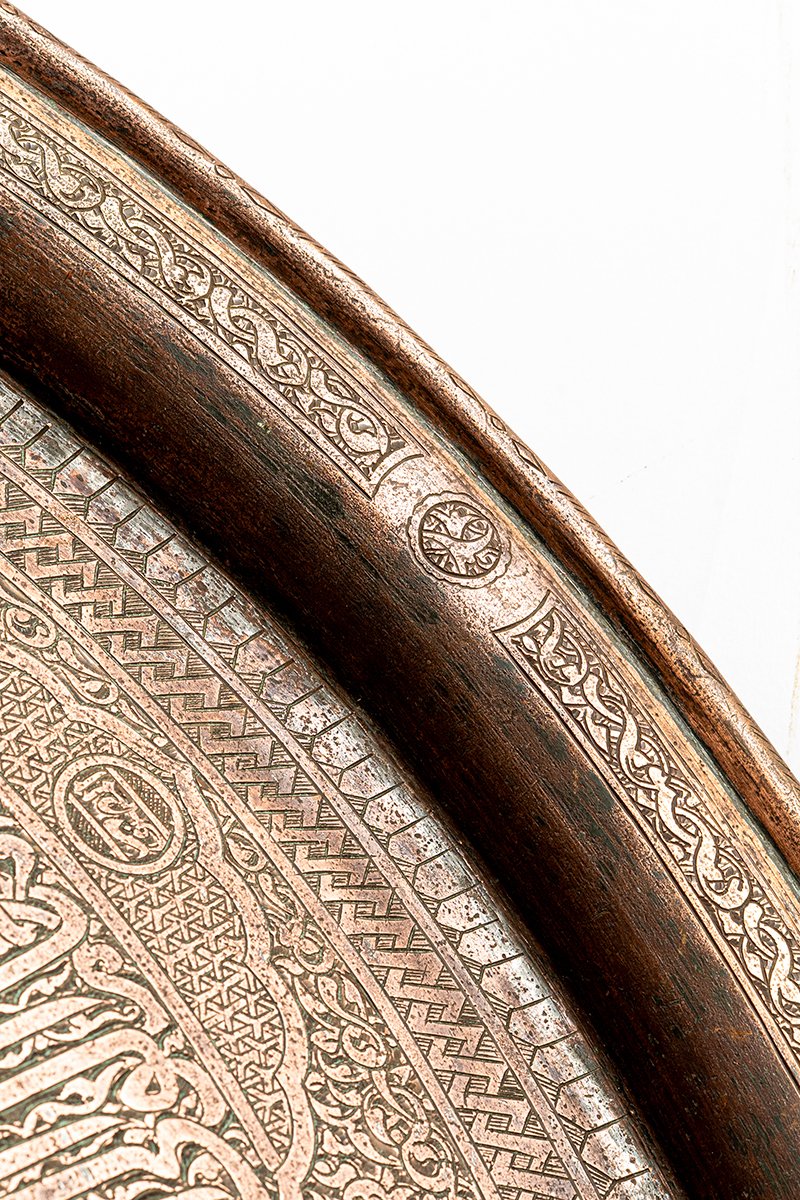
The borders are equally deliberate: interlaced geometric knots, tessellated stars, vegetal arabesques, and further inscriptions create a fortress-like outer band, enclosing the imagery and giving the surface an impression of constant circulation, a world turning endlessly around its luminous center.
Calligraphic Inscriptions
The surrounding inscriptions extol the Sultan with honorific titles:
"الناصر المنصور المحارب المجاهد المؤيد الوالي"
Transliteration:
al-Nāṣir al-Manṣūr al-Muḥārib al-Mujāhid al-Muʾayyad al-Wālī
Translation:
“The Victorious, the Triumphant, the Warrior, the Fighter in God’s cause, the Supported, the Protector.”
At the core lies the Sultan’s emblem (ختم – khatm), circled by bands of Mamluk calligraphy in bold, rhythmic form, binding the design with authority.
Artistic Details
- Six Knights: Each knight is distinct in pose, weapon, and attire, one hunting deer, others raising lances or engaged in ritual motion, together symbolizing the Sultan’s domains and martial guardianship.
- Royal Portraits: In one register, depictions of the king, princes, and attendants appear, marking the tray as a ceremonial celebration of the Sultan’s court.
- Vegetal Arabesques: Nabatiyāt Islāmiyya (نباتيات إسلامية), Islamic leaf designs, fill the background, flowing between cartouches and text, merging nature and word.
- Geometric Ornament: Star tessellations and lattice knots frame the cartouches, emphasizing the harmony of Mamluk geometry.
- Fortified Rim: The outermost band, filled with script and arabesque patterns, rises like a protective wall, enclosing the narrative within a cosmic cycle.
Interpretation
This tray is a chronicle of power and devotion, where script and image narrate the Sultan’s sovereignty. At its heart, the emblem anchors the design with divine legitimacy; around it, inscriptions of praise echo authority; and in its roundels, knights, courtiers, and huntsmen animate the surface with martial vigor and courtly ceremony. The hunted deer, the vigilant riders, the flowing calligraphy, and the vegetal scrolls combine to proclaim a vision of Mamluk kingship as both warrior’s might and divine stewardship,a kingdom encircled in perpetual harmony and motion.